Showing posts with label los alamos. Show all posts
Friday, May 4, 2012
Monday, April 2, 2012
A snowy April 2 in Los Alamos
This is the scene in our back yard as of an hour or so ago. That is, snowing heavily with 4-5" of accumulation in some places. I think it’s great. I believe I’ve mentioned before that the only acceptable weather conditions are blizzard and brilliantly sunny.
The branches covered in blossoms catch the snow best.
Sunday, March 18, 2012
Cave of the Winds revisited
A few days ago, I got a request from PEEC asking if they could use photos from my November post on Cave of the Winds. I said sure; they also wondered if I had photos of the cave entrance and inside the cave. I said no, but I’d be happy to go up and make some, which I did this morning. It was terrifically windy.
I watched this tree fall over. I considered turning around, but decided that since there weren’t too many trees, paying more attention to the few trees I was passing was enough to keep me reasonably safe. I didn’t see any more fresh falls.
Turn-off to Cave of the Winds.
Cave of the Winds entrance, looking east (downstream). The descent from the rim is quite steep and ends in a drop-off.
Cave entrance looking west (upstream).
Inside the cave. There is one main room and a few short side passages, and as far as I can tell, no bears (I checked).
I watched this tree fall over. I considered turning around, but decided that since there weren’t too many trees, paying more attention to the few trees I was passing was enough to keep me reasonably safe. I didn’t see any more fresh falls.
Turn-off to Cave of the Winds.
Cave of the Winds entrance, looking east (downstream). The descent from the rim is quite steep and ends in a drop-off.
Cave entrance looking west (upstream).
Inside the cave. There is one main room and a few short side passages, and as far as I can tell, no bears (I checked).
Saturday, March 10, 2012
East Fork Trail hike
Last weekend, Erin and I went on a hike down the East Fork Trail with Amanda, Isaac, and their optimistically-named dog Thor.
Thursday, March 1, 2012
Rendija Canyon in yellow and blue
One of the interesting things one can do in black and white photography is change which colors are represented in the final image. For example, the following two images are two interpretations of the same capture:
This one is a yellow “filter”; that is, the brightness in yellow has more influence on the final result than brightness in other colors. This is a fairly common treatment.
Back in the days of film, one had to make filter choices ahead of time and use actual pieces of colored glass. Now it’s all done in software.
This is a blue “filter”. These days it’s more unusual, but many of the first films responded only to blue, leading to the washed out skies look of photographs made with those films.
This one is a yellow “filter”; that is, the brightness in yellow has more influence on the final result than brightness in other colors. This is a fairly common treatment.
Back in the days of film, one had to make filter choices ahead of time and use actual pieces of colored glass. Now it’s all done in software.
This is a blue “filter”. These days it’s more unusual, but many of the first films responded only to blue, leading to the washed out skies look of photographs made with those films.
Wednesday, February 29, 2012
Monday, February 27, 2012
Why forest people should support Option 2 of the golf course improvement/expansion
After several weeks off, the golf course issue is back again — there are a couple of public meetings soon, one on Wednesday for the Parks & Rec Board to consider the proposals, and another for the Capital Improvements Board to consider them (the final step before the County Council).
Anyway, you may recall that my initial position was that we shouldn’t cut down any trees at all to accommodate a golf course project. After being pretty thoroughly involved in the process, and talking with forest people as well as Andy Staples, the golf course architect, and seeing the new options emerge, I’ve changed my mind.
Specifically, I believe that people like myself who care a lot about forests and trails, and who do not care at all about golf, should nevertheless support Option 2. This option gives up a few acres of trees and puts golf on the rim of a canyon which right now is moderately secluded — which I don’t like, but I think supporting this option has more benefits than drawbacks.
Specifically, those benefits are: (a) it would make golfers much happier than Option 1 or leaving the layout unchanged, which means it would be a long-term solution and we won’t be having this same conversation again in 10 years, and (b) it builds political capital that will be valuable in seeking broader open space protections across the county (and conversely, opposing the project destroys political capital that we need). Also, we still get item B even if the plan fails!
You might ask: “Don’t we already have good de facto protection of open space in the county? And isn’t public opposition such that we can be fairly confident of blocking future development proposals?” The answers turn out to be no and no. For example, here are some development proposals from the past 20 years (compiled by Craig Martin, who is awesome; this list is an edited quote from his post in the Los Alamos Trails Facebook group):
Opposing what is a modest expansion, compared to what golfers would choose if they had their druthers, makes us look selfish and inflexible, given that the golf course is also open space (a lesser form of open space, in my opinion, but open space nonetheless). Previous efforts to build comprehensive open space protection have failed for exactly this reason.
Finally, I don’t have concerns about the cost of the project, especially since Option 2 is not much more expensive than Option 1: if one will fail on a cost basis, both will. We can afford it, quality infrastructure costs money, and it’s really decades of deferred maintenance, not a fancy new facility.
For these reasons, I believe we should support Option 2 and take advantage of the momentum this process has generated to create comprehensive protection for open space in Los Alamos County.
Anyway, you may recall that my initial position was that we shouldn’t cut down any trees at all to accommodate a golf course project. After being pretty thoroughly involved in the process, and talking with forest people as well as Andy Staples, the golf course architect, and seeing the new options emerge, I’ve changed my mind.
Specifically, I believe that people like myself who care a lot about forests and trails, and who do not care at all about golf, should nevertheless support Option 2. This option gives up a few acres of trees and puts golf on the rim of a canyon which right now is moderately secluded — which I don’t like, but I think supporting this option has more benefits than drawbacks.
Specifically, those benefits are: (a) it would make golfers much happier than Option 1 or leaving the layout unchanged, which means it would be a long-term solution and we won’t be having this same conversation again in 10 years, and (b) it builds political capital that will be valuable in seeking broader open space protections across the county (and conversely, opposing the project destroys political capital that we need). Also, we still get item B even if the plan fails!
You might ask: “Don’t we already have good de facto protection of open space in the county? And isn’t public opposition such that we can be fairly confident of blocking future development proposals?” The answers turn out to be no and no. For example, here are some development proposals from the past 20 years (compiled by Craig Martin, who is awesome; this list is an edited quote from his post in the Los Alamos Trails Facebook group):
- A proposed “emergency access road” through the middle of open space on the White Rock Canyon Rim in Overlook Park.
- Housing on the Western Perimeter Tract above 48th Street where the Perimeter Trail traverses LA Mountain.
- A housing area and commercial uses on transfer lands (from DOE to the County) in Pueblo Canyon below Anderson Overlook.
- Housing development in lower Bayo Canyon.
- Expansion of housing into Rendija Canyon following transfer from DOE.
- A proposal to move the golf course into Rendija Canyon and develop housing at the current golf course.
- A proposal to move the stables into Rendija Canyon and develop housing at the stable area.
- Housing development on public land across from Pajarito School on Arizona Avenue.
- Development of Otowi Mesa, which is now Los Pueblos (the road and housing).
- The tip of “airport mesa”, now the Pajarito Cliffs Site.
- A proposed pipeline from the Rio Grande to White Rock through White Rock Canyon below the Overlook.
Opposing what is a modest expansion, compared to what golfers would choose if they had their druthers, makes us look selfish and inflexible, given that the golf course is also open space (a lesser form of open space, in my opinion, but open space nonetheless). Previous efforts to build comprehensive open space protection have failed for exactly this reason.
Finally, I don’t have concerns about the cost of the project, especially since Option 2 is not much more expensive than Option 1: if one will fail on a cost basis, both will. We can afford it, quality infrastructure costs money, and it’s really decades of deferred maintenance, not a fancy new facility.
For these reasons, I believe we should support Option 2 and take advantage of the momentum this process has generated to create comprehensive protection for open space in Los Alamos County.
Tuesday, February 21, 2012
Gonzales Canyon hike
On Friday, Erin and I walked down “Gonzalez Canyon” just north of Camino de Encantado on Barranca Mesa. We wanted to check out an apparent road bed that we had seen from across the canyon.
There are lots of “character trees” around Los Alamos, but this one really caught my eye. It is two independent trunks emerging from the ground, apparently merging, and then splitting again.
Trail on the north side of Gonzales Canyon.
Forts are awesome. I had a great time playing in forts in the woods when I was a kid. I’ve heard rumor that some folks want to prevent kids from building forts in the woods, to keep them pristine. That seems like a terrible idea to me — IMO a great way to build a love of the outdoors in children is to let them do childish things outside.
We weren’t exactly sure what to make of the “road bed”. It seemed too steep to be a road, yet too wide and too enthusiastically cut from the hillside to be just for a pipeline. (I don’t know if there’s anything in this particular trench, but lower down there was a manhole cover with running water inside.)
Looking toward the Sangres from just south of Los Pueblos.
Keep in mind this is the middle of town, folks. I still can’t get over that.
There are lots of “character trees” around Los Alamos, but this one really caught my eye. It is two independent trunks emerging from the ground, apparently merging, and then splitting again.
Trail on the north side of Gonzales Canyon.
Forts are awesome. I had a great time playing in forts in the woods when I was a kid. I’ve heard rumor that some folks want to prevent kids from building forts in the woods, to keep them pristine. That seems like a terrible idea to me — IMO a great way to build a love of the outdoors in children is to let them do childish things outside.
We weren’t exactly sure what to make of the “road bed”. It seemed too steep to be a road, yet too wide and too enthusiastically cut from the hillside to be just for a pipeline. (I don’t know if there’s anything in this particular trench, but lower down there was a manhole cover with running water inside.)
Looking toward the Sangres from just south of Los Pueblos.
Keep in mind this is the middle of town, folks. I still can’t get over that.
Sunday, February 19, 2012
Another blog, OMG! And this one needs your help
I’m launching (or really re-launching — I took over earlier this month) another blog. This one is called Los Alamos Daily Photo and it’s a collaborative photo diary of Los Alamos related places, people, things, events, and whatever else you can think of. Please send me your photos! (Instructions over at LADP.)
Los Alamos weather forecast confusion
Today's weather forecast. Note particularly "chance of precipitation" for today and tomorrow versus the "Regional Forecast". There is also a Winter Weather Advisory that I have not shown.
This dissonance happens all the time.
Saturday, January 28, 2012
Camino Encantado loop
Yesterday, Erin and I walked a loop off Barranca Mesa and along Bayo Canyon, circumnavigating Camino Encantado. Much of this is along old roads, which is kind of cool. I checked a book on the topic out of the library and am looking forward to reading it.
In the homestead era, this road along a bench in Bayo Canyon was one of the principal routes up to the Pajarito Plateau. I suspect it looked much as it does now. There is a rather impressive drop a few feet to the right.
This is where one of the town’s sewer lines dives off the mesa.
Thursday, January 26, 2012
Ashley Pond renovations?
![]() |
| Photo by 77krc@Flickr / CC-BY-NC-ND |
At the moment and for much as long as I can remember, Ashley Pond is a pretty lame pond. It’s basically a large concrete bathtub with ducks — no natural shoreline, water plants (aside from algae slime), or beaches of any kind. Depressing 1950’s suburbia to the max.
Anyway, there is a county project in the works to do some rebuilding. I hope this goes forward and the pond becomes more like a pond and less like a bathtub. As always, they’re taking comments; send yours to anne.laurent@lacnm.us. Be sure to mention robots.
Sunday, January 22, 2012
New golf course options and a tour of potentially impacted areas
Update 1/26: Craig learned some more concrete information about the plan details, which makes some of the content below a little misleading. I’ve added a few updates in-line.
The golf course improvement/expansion project continues. The result of the meetings two weeks ago is two new options (the previous lettered options are now off the table). Below are sketch maps of the new options, my comments, and some photos from a tour of the potentially impacted areas led by Craig Martin earlier today.
New Option 1
This option more or less rebuilds the course in place. Details matter, of course — there is some encroachment into the forest, both along the edges and into interior islands (for example, I worry about holes 4, 11, 15, and 16). But assuming the above accurately represents the actual tree loss, I could probably live with this.
The problem with this one is that it seems to have limited appeal to golfers, as far as I can tell. So if we do this, will we be having exactly the same discussion in ten years? I think everyone is much better served if we can come up with a true long-term solution. (Of course, if golfers are dissatisfied because it’s only a great community course rather than a “destination”, then I have pretty much no sympathy.)
New Option 2
This option has similar encroachment as Option 1, with two significant exceptions: Holes 4 and especially 17. Considered independently, this option is not acceptable. There is too much tree loss (we’ve just confirmed that some of these trees are 350 years old), and it totally changes the character of a secluded and remarkable viewpoint.
The upside is that the golfers seem to like this one. While Option 2 alone I could never support (simply reducing one’s demands is not a compromise; a true compromise has something in it for both sides), I believe we might make something of it. I do believe there’s a lot of value in an outcome that both sides are genuinely happy with, rather than an outcome which one side only grudgingly accepts. More on this later.
Today’s tour
Earlier today, Craig Martin generously led a tour of Option 2’s holes 17 and 4 to show folks what the impact on the ground might be. Unfortunately, all we had to go on was sketches like the ones above, so we had to do a fair amount of guessing. And there’s another layer of interpretation in my own descriptions below, so please don’t assume these are definitive.
Craig and his wife June spend a few hours flagging and staking before we arrived. Thus, you can go independently and check things out for yourself.
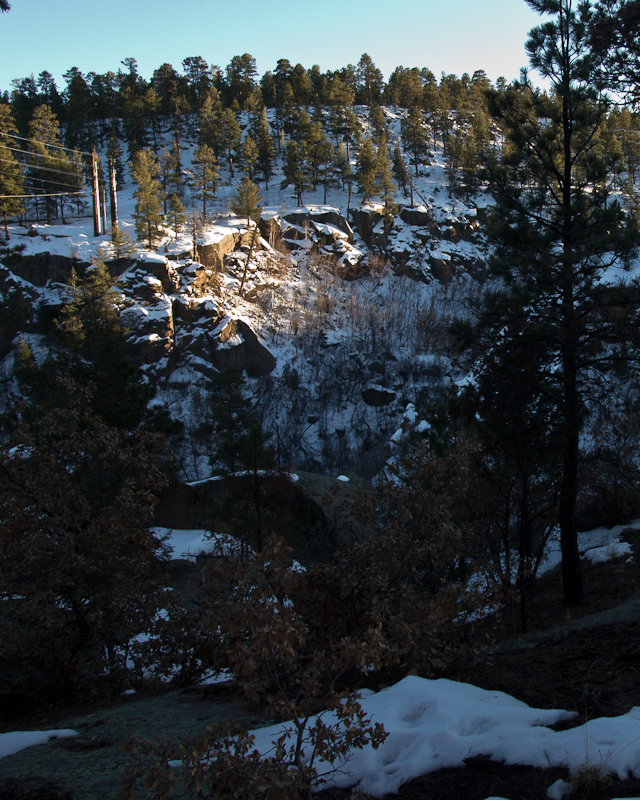
This is the tee area of Hole 17. I’m standing at the edge of what we think would be cleared; more or less all the visible trees from where I’m standing to the canyon rim (about 130 feet straight ahead) would be removed.
Update 1/26: Craig says: “The tee area for hole 17 is further to the south than I guessed, so fewer trees would have to be removed.” So some of the trees in this photo would go, but not all.
Same view point but angled more to the right. I think the two large trees at the right of the photo might be saved, but everything else between here and the rim would go, with perhaps less risk in the right 1/3 of the frame.
View from the tee area to the fairway on the other side of the canyon. It was unclear to us how many of the trees in the canyon would need to come down (the design team has proposed “topping” them, but any meaningful topping would kill the trees anyway).
Update 1/26: Branch removal would have a lighter touch than we thought; no trees in the canyon bottom are targeted for removal, and a couple would have branches removed but not enough to risk killing them.
View from the fairway area of Hole 17. I believe more or less all the trees between here and the canyon rim would go, along with a few more outside the right side of the frame.
Finally, this is the proposed Hole 4 under Option 2. Trees with pink flags would go; basically, count four trees in along the first row of trees and extend something that wide down to where the power lines turn right (hard to see in this photo, unfortunately).
Closing
In no particular order:
The golf course improvement/expansion project continues. The result of the meetings two weeks ago is two new options (the previous lettered options are now off the table). Below are sketch maps of the new options, my comments, and some photos from a tour of the potentially impacted areas led by Craig Martin earlier today.
New Option 1
This option more or less rebuilds the course in place. Details matter, of course — there is some encroachment into the forest, both along the edges and into interior islands (for example, I worry about holes 4, 11, 15, and 16). But assuming the above accurately represents the actual tree loss, I could probably live with this.
The problem with this one is that it seems to have limited appeal to golfers, as far as I can tell. So if we do this, will we be having exactly the same discussion in ten years? I think everyone is much better served if we can come up with a true long-term solution. (Of course, if golfers are dissatisfied because it’s only a great community course rather than a “destination”, then I have pretty much no sympathy.)
New Option 2
This option has similar encroachment as Option 1, with two significant exceptions: Holes 4 and especially 17. Considered independently, this option is not acceptable. There is too much tree loss (we’ve just confirmed that some of these trees are 350 years old), and it totally changes the character of a secluded and remarkable viewpoint.
The upside is that the golfers seem to like this one. While Option 2 alone I could never support (simply reducing one’s demands is not a compromise; a true compromise has something in it for both sides), I believe we might make something of it. I do believe there’s a lot of value in an outcome that both sides are genuinely happy with, rather than an outcome which one side only grudgingly accepts. More on this later.
Today’s tour
Earlier today, Craig Martin generously led a tour of Option 2’s holes 17 and 4 to show folks what the impact on the ground might be. Unfortunately, all we had to go on was sketches like the ones above, so we had to do a fair amount of guessing. And there’s another layer of interpretation in my own descriptions below, so please don’t assume these are definitive.
Craig and his wife June spend a few hours flagging and staking before we arrived. Thus, you can go independently and check things out for yourself.
This is the tee area of Hole 17. I’m standing at the edge of what we think would be cleared; more or less all the visible trees from where I’m standing to the canyon rim (about 130 feet straight ahead) would be removed.
Update 1/26: Craig says: “The tee area for hole 17 is further to the south than I guessed, so fewer trees would have to be removed.” So some of the trees in this photo would go, but not all.
Same view point but angled more to the right. I think the two large trees at the right of the photo might be saved, but everything else between here and the rim would go, with perhaps less risk in the right 1/3 of the frame.
View from the tee area to the fairway on the other side of the canyon. It was unclear to us how many of the trees in the canyon would need to come down (the design team has proposed “topping” them, but any meaningful topping would kill the trees anyway).
Update 1/26: Branch removal would have a lighter touch than we thought; no trees in the canyon bottom are targeted for removal, and a couple would have branches removed but not enough to risk killing them.
View from the fairway area of Hole 17. I believe more or less all the trees between here and the canyon rim would go, along with a few more outside the right side of the frame.
Finally, this is the proposed Hole 4 under Option 2. Trees with pink flags would go; basically, count four trees in along the first row of trees and extend something that wide down to where the power lines turn right (hard to see in this photo, unfortunately).
Closing
In no particular order:
- One thing that became very clear during this tour is that details matter a lot. The forest is not amorphous; it’s a collection of individual trees. Thus, trees need to be analyzed for removal or preservation as individuals, and there needs to be room for on-the-ground negotiation regarding individual trees. Forest people must be intimately involved in these decisions, and minimization of tree loss must be a priority at all stages.
- As I mentioned, I don’t like Option 2. But, if there were something added to the deal which was of sufficient value to forest people like myself, I could live with it. Things that have been proposed which are of no value IMO are infrastructure (I don’t need any to walk in the woods) and planting native vegetation (does not replace mature ponderosas). What would be of value to me is additional open space protections in the county. The key is additional — the new protections would have to go significantly beyond the de facto protections currently enforced by public opinion as well as what we could expect to achieve without giving up forest for the golf course.
- One other thing that I think would be super cool, particularly as someone with children on the way, is mini golf. I wonder if there’s a way to fit that in without additional tree loss. That would make the course much more of a community place than a golfer place.
- Finally, I haven’t addressed the financial issues (the cost of these changes may approach $10 million); I don’t personally object to spending the money, but I’ve heard a lot of griping about it. I should also add that I’m still skeptical of the safety argument and completely unconvinced that any realistic golf course in Los Alamos can really be a regional draw.
Wednesday, January 18, 2012
Monday, January 16, 2012
New Year’s Day walk
On New Year’s Day, Erin and I walked down Olive street past the site of the old sewage treatment plant and down Pueblo Canyon to the Walnut Street Playlot.
Sunday, January 15, 2012
Controlled burn in Los Alamos
The woods around Los Alamos are on fire again — but they’re supposed to be that way. Apparently the Los Alamos wildfire plan (big PDF) calls for continual maintenance of the local forests by several methods, including fire. I think this is super cool; my intuition would be that the community simply wouldn’t tolerate fire in the woods near town.
In this case, what’s happening is that over the past months or years, crews have gathered excess wood and other fuel from the forest floor into piles, and now that there’s snow on the ground, they are burning the piles. The above photo was taken yesterday afternoon, when over 100 fires were burning in Walnut Canyon. The county has a pretty good website explaining the details.
Wednesday, January 11, 2012
Golf course expansion/improvement process update
I attended one of several working group sessions this afternoon to talk about the golf course expansion/improvement project. It was pretty intense, though generally productive. Kudos to Andy Staples and the rest of the project team for putting up with four of these!
Below is my follow up letter to Andy (with a few formatting modifications). After all, I have to keep up my reputation for lengthy written comments.
The county’s project page is here, and they are still accepting comments at cpfd@lacnm.us.
Andy,
Thanks again for meeting with me and other community members! I felt like my opinions matured as a result, and I remain optimistic that we will be able to come to a solution which is satisfactory to generally all points of view. In particular, I feel like you are a guy we can work with, and I look forward to doing so further.
I won’t be able to make the summary meeting tomorrow, but I hope that my further comments in this e-mail will be of use during that discussion. I am also happy to work further in whatever capacity is useful. In particular, I’m happy to meet with whoever, exchange e-mails, or talk on the phone if these things would be helpful.
This note builds on my earlier comments regarding the project. I’ll focus on three things: mapping the golf course footprint, what a potential deal might look like, and arguments that I still feel haven’t been made adequately.
The golf course footprint
I liked that we tried to map the existing golf course footprint. I felt that we did not succeed, however, due both to time constraints as well as the fact that the boundary turns out to be more complex than we (certainly I) expected.
I spent a little time with Google Earth and sketched out a “footprint” that matches how I feel. It’s pretty rough, but I think the basic idea will come across. The core of this sketch is that I have divided the trees around the golf course into three classes.
Outlines of a potential deal
I still believe that the goal should be zero trees down. To be persuaded otherwise, here is a structure of argument that I might find convincing. The crux is demonstrating clearly that leaving all trees in a given class standing is unworkable. One way to present this argument is to offer options that fall into the following categories:
For offsetting loss of trees, I first mention a couple of things that I find unattractive. Infrastructure such as trailhead facilities or trail surface improvement is of little use to me. Similarly, planting “replacement” vegetation simply takes too long to mature: even fast-growing trees will be only beginning to mature within my lifetime, and mature ponderosas near the golf course are, I am told, 200-300 years old despite their smallish size.
The key thing that a good deal could offer to forest people is broad protection of other forests within the county. In my opinion, there would be two key components to such an offer. First, it would need to be a package deal: no fix golf course now with a promise of figuring out the details of forest protections later. Do it all at the same time. Second, it would need to go significantly beyond existing protections; for example, many formally unprotected forests in this down have de facto protection due simply to public resistance to change.
Arguments which need to be developed further
I’m still not convinced by the safety arguments made thus far. Specifically in response to today’s meeting, the envelope standard seems arbitrary to me. It’s clearly based on a probability contour (i.e., X% of golf balls stay within the envelope), but the value of X is unspecified. How was the contour computed? What is X? How was it chosen? For example, we as a community can’t decide that (for example) 1/2X is an acceptable tradeoff to reach other goals. Is there any way to provide multiple envelopes with different (and specified) values of X?
In terms of liability concerns, couldn’t appropriate signage on the trails mitigate these?
Finally, it is unclear which designs are targeting the goal of a becoming a destination course and which target simply becoming a great community course. I would like this to be explicit for each option. I’ve said this earlier, so I won’t repeat myself too much, but I haven’t seen any coherent argument that it is indeed possible to become a destination course given our isolated location. If the designs continue to target this, I believe it is important to present the data and economic analysis which support the viability of this goal.
Again, thank you for listening. Please let me know if I can clarify anything or be of assistance in any way.
Below is my follow up letter to Andy (with a few formatting modifications). After all, I have to keep up my reputation for lengthy written comments.
The county’s project page is here, and they are still accepting comments at cpfd@lacnm.us.
Andy,
Thanks again for meeting with me and other community members! I felt like my opinions matured as a result, and I remain optimistic that we will be able to come to a solution which is satisfactory to generally all points of view. In particular, I feel like you are a guy we can work with, and I look forward to doing so further.
I won’t be able to make the summary meeting tomorrow, but I hope that my further comments in this e-mail will be of use during that discussion. I am also happy to work further in whatever capacity is useful. In particular, I’m happy to meet with whoever, exchange e-mails, or talk on the phone if these things would be helpful.
This note builds on my earlier comments regarding the project. I’ll focus on three things: mapping the golf course footprint, what a potential deal might look like, and arguments that I still feel haven’t been made adequately.
The golf course footprint
I liked that we tried to map the existing golf course footprint. I felt that we did not succeed, however, due both to time constraints as well as the fact that the boundary turns out to be more complex than we (certainly I) expected.
I spent a little time with Google Earth and sketched out a “footprint” that matches how I feel. It’s pretty rough, but I think the basic idea will come across. The core of this sketch is that I have divided the trees around the golf course into three classes.
![]() |
| (click for bigness) |
- Class A: The red trees are those that are most important. In my opinion it is basically unacceptable to cut any of these down. Any deal which does propose cutting these trees would need to offer very strong justification for each individual tree lost as well as very significant value to forest people elsewhere in the county, to offset for the loss.
- Class B: The magenta trees are important, but somewhat less so. In my opinion it is unacceptable to cut any of these down absent strong justification for removing each individual tree. A deal which removes these trees would need to offer significant value to forest people elsewhere in the county.
- Class C: I consider these trees part of the golf course, and
thus I feel it is up to the golf course to decide what to do
with them. Many are deciduous trees planted (I assume) during
the original construction. I still consider these trees quite
valuable, and I would hope that the design minimizes
their loss, but I don't feel such loss requires offsetting to
make an acceptable deal.
Outlines of a potential deal
I still believe that the goal should be zero trees down. To be persuaded otherwise, here is a structure of argument that I might find convincing. The crux is demonstrating clearly that leaving all trees in a given class standing is unworkable. One way to present this argument is to offer options that fall into the following categories:
- One or more options which leave all trees in Classes A and B standing.
- One or more options which leave all trees in Class A standing.
- One or more options which cut in both Classes A and B.
For offsetting loss of trees, I first mention a couple of things that I find unattractive. Infrastructure such as trailhead facilities or trail surface improvement is of little use to me. Similarly, planting “replacement” vegetation simply takes too long to mature: even fast-growing trees will be only beginning to mature within my lifetime, and mature ponderosas near the golf course are, I am told, 200-300 years old despite their smallish size.
The key thing that a good deal could offer to forest people is broad protection of other forests within the county. In my opinion, there would be two key components to such an offer. First, it would need to be a package deal: no fix golf course now with a promise of figuring out the details of forest protections later. Do it all at the same time. Second, it would need to go significantly beyond existing protections; for example, many formally unprotected forests in this down have de facto protection due simply to public resistance to change.
Arguments which need to be developed further
I’m still not convinced by the safety arguments made thus far. Specifically in response to today’s meeting, the envelope standard seems arbitrary to me. It’s clearly based on a probability contour (i.e., X% of golf balls stay within the envelope), but the value of X is unspecified. How was the contour computed? What is X? How was it chosen? For example, we as a community can’t decide that (for example) 1/2X is an acceptable tradeoff to reach other goals. Is there any way to provide multiple envelopes with different (and specified) values of X?
In terms of liability concerns, couldn’t appropriate signage on the trails mitigate these?
Finally, it is unclear which designs are targeting the goal of a becoming a destination course and which target simply becoming a great community course. I would like this to be explicit for each option. I’ve said this earlier, so I won’t repeat myself too much, but I haven’t seen any coherent argument that it is indeed possible to become a destination course given our isolated location. If the designs continue to target this, I believe it is important to present the data and economic analysis which support the viability of this goal.
Again, thank you for listening. Please let me know if I can clarify anything or be of assistance in any way.
Sunday, January 8, 2012
More on monopoly issues at the Trinity Site
It seems my previous post on the Trinity Site redevelopment generated more interest than I expected; somehow it found its way to the attention of the site's citizen advisory committee. Three members proceeded to write thoughtful comments on the post. I suspect they may have useful things to say here as well.
First, I want to emphasize that my critique should in no way diminish my appreciation for the effort members of the advisory committee and other project folks have put in. Clearly, it's been a massive amount of work. I am also on board with, in principle, the desirability of the project and an expanded Smith's across the road.
That said, based on what I've seen, I'm still not convinced the monopoly/conflict of interest issues have been adequately mitigated. In addition to the Gibson editorial, I've read through the newsletter sent to all residents on Friday as well as poked around the county's project website. I confess I have not read all 100+ pages of the (non-searchable) proposed ordinance nor all the documents on the site. (Frankly, it's rather poorly organized, in my opinion, and I couldn't find an objective summary or FAQ.) However, I believe I know enough to have a meaningful opinion. (And if I have missed something substantive, please do point me to what I missed.)
An obvious potential tenant for Mari-Mac is the co-op. I realize that given the fact that we (I am a co-op member) just spent a pile of money on a brand new building, we are obviously not moving any time soon. But we might want to do so sometime in the next 73 years, which is how long the Trinity Site agreement appears to run.
Also, the reason we (I am a co-op member) are out past the airport -- frankly, a rotten location -- is that after years of trying, the membership was unable to secure a better location. In fact, if I recall correctly, the membership did pursue a location at the Trinity Site, but this did not work out for some reason. This difficulty is clear evidence that retail real estate in Los Alamos is quite limited. The membership at the time decided, essentially, that a rotten location was better than no co-op at all.
Anyway, Kroger being landlord at Mari-Mac as well as a diverse anchor tenant at Trinity Site is a clear conflict of interest. An independent landlord at Mari-Mac would evaluate potential tenants based on their ability to provide revenue for the landlord; a landlord that also owns a large retailer itself will additionally consider whether tenants will compete with its own retail operation. This is a conflict of interest and a worrisome monopoly situation.
The new Smith's will be a "Smith's Marketplace", which has a much more diverse product offering than the existing Smith's grocery store. Based on the Smith's Marketplace in Salt Lake City, where I've been a couple of times, possible offerings include the following:
Commenters on the previous post assure me that the monopoly issue was considered at length, but all I could find on the county's website was a couple of fairly vague paragraphs in the "NADG Written Response to TSRPAC Questions" PDF. So it's unclear to me what the result of this consideration was. If there was some concrete outcome, I'd love to see it.
Conflicts of interest aren't necessarily deal breakers, but they need to be mitigated. For example, is Kroger expected to sell Mari-Mac within a few years? Great -- put it in writing. Do we expect that these conflicts of interests will not in fact result in problematic limitations for our community? Again, great -- put it in writing. Give us some recourse if this expectation turns out to be unfounded. I'm sure that there are opportunities to write the necessary protections into the agreement in ways that also satisfy business realities.
I can assure you that Kroger, like any large corporation, does not care one whit about our community. Their sole purpose is to make money. This is how American capitalism works these days (withholding further comment on this matter for now). And if for some reason Kroger is exempt from this critique, they, like any company, face sale to a different company with fewer scruples. We should recognize this and write appropriate protections into the agreement.
It does seem the process has considered the monopoly/conflict of interest issue, but it's not clear what, if anything, has been done about it. The proposal needs to be more accountable to the community on this issue and how it is being mitigated.
First, I want to emphasize that my critique should in no way diminish my appreciation for the effort members of the advisory committee and other project folks have put in. Clearly, it's been a massive amount of work. I am also on board with, in principle, the desirability of the project and an expanded Smith's across the road.
That said, based on what I've seen, I'm still not convinced the monopoly/conflict of interest issues have been adequately mitigated. In addition to the Gibson editorial, I've read through the newsletter sent to all residents on Friday as well as poked around the county's project website. I confess I have not read all 100+ pages of the (non-searchable) proposed ordinance nor all the documents on the site. (Frankly, it's rather poorly organized, in my opinion, and I couldn't find an objective summary or FAQ.) However, I believe I know enough to have a meaningful opinion. (And if I have missed something substantive, please do point me to what I missed.)
An obvious potential tenant for Mari-Mac is the co-op. I realize that given the fact that we (I am a co-op member) just spent a pile of money on a brand new building, we are obviously not moving any time soon. But we might want to do so sometime in the next 73 years, which is how long the Trinity Site agreement appears to run.
Also, the reason we (I am a co-op member) are out past the airport -- frankly, a rotten location -- is that after years of trying, the membership was unable to secure a better location. In fact, if I recall correctly, the membership did pursue a location at the Trinity Site, but this did not work out for some reason. This difficulty is clear evidence that retail real estate in Los Alamos is quite limited. The membership at the time decided, essentially, that a rotten location was better than no co-op at all.
Anyway, Kroger being landlord at Mari-Mac as well as a diverse anchor tenant at Trinity Site is a clear conflict of interest. An independent landlord at Mari-Mac would evaluate potential tenants based on their ability to provide revenue for the landlord; a landlord that also owns a large retailer itself will additionally consider whether tenants will compete with its own retail operation. This is a conflict of interest and a worrisome monopoly situation.
The new Smith's will be a "Smith's Marketplace", which has a much more diverse product offering than the existing Smith's grocery store. Based on the Smith's Marketplace in Salt Lake City, where I've been a couple of times, possible offerings include the following:
- Clothing. Is Beall's at risk?
- Shoes.
- Liquor.
- Books.
- Furniture.
- Drugs, cosmetics, and other pharmacy items. (The proposal is explicit that a pharmacy would probably be excluded.)
- Plants, flowers, and other garden stuff.
- Hardware.
- Produce. Would a farmer's market be excluded from the parking lot?
- A butcher's counter.
- Electronics.
Commenters on the previous post assure me that the monopoly issue was considered at length, but all I could find on the county's website was a couple of fairly vague paragraphs in the "NADG Written Response to TSRPAC Questions" PDF. So it's unclear to me what the result of this consideration was. If there was some concrete outcome, I'd love to see it.
Conflicts of interest aren't necessarily deal breakers, but they need to be mitigated. For example, is Kroger expected to sell Mari-Mac within a few years? Great -- put it in writing. Do we expect that these conflicts of interests will not in fact result in problematic limitations for our community? Again, great -- put it in writing. Give us some recourse if this expectation turns out to be unfounded. I'm sure that there are opportunities to write the necessary protections into the agreement in ways that also satisfy business realities.
I can assure you that Kroger, like any large corporation, does not care one whit about our community. Their sole purpose is to make money. This is how American capitalism works these days (withholding further comment on this matter for now). And if for some reason Kroger is exempt from this critique, they, like any company, face sale to a different company with fewer scruples. We should recognize this and write appropriate protections into the agreement.
It does seem the process has considered the monopoly/conflict of interest issue, but it's not clear what, if anything, has been done about it. The proposal needs to be more accountable to the community on this issue and how it is being mitigated.
Tuesday, January 3, 2012
A boondoggle brewing in downtown Los Alamos?
Update 1/7: Please see the comments below, from members of the community advisory committee, for useful additional perspective.
Update 1/8: Comments on this post are closed. Please see the follow-up post.
There’s a large plot of vacant land in downtown Los Alamos, across Trinity Drive from Smith’s and the rest of the Mari-Mac Shopping Center. I believe it was formerly occupied by the school administration complex which has moved out past the airport.
The current plan to redevelop the parcel (awkwardly named Trinity Site — folks, there’s already one of those) is to build a new and bigger Smith’s along with some other unspecified retail; you can read about the gory details on the county’s website.
I hadn’t paid much attention to the project until I read Robert Gibson’s editorial in the January 1 Monitor (login required, sorry). He points out several problems, but here’s the one I find most troublesome. The root of the problem is that Smith’s (and its parent company, Kroger) already controls the entire Mari-Mac Shopping Center (the retail area surrounding Smith’s). I quote:
Sounds like a terrible idea to me. If the project goes forward with a Smith’s anchor in the new site, Kroger should be required to divest its interest in Mari-Mac. Or, we could just scrap the plan and do something better.
If you agree, please send your comments to the county. Kelly Stewart is collecting them at trinitysite.info@lacnm.us (note that as of this writing, the e-mail address at the bottom of the county web page is incorrect).
Update 1/8: Comments on this post are closed. Please see the follow-up post.
There’s a large plot of vacant land in downtown Los Alamos, across Trinity Drive from Smith’s and the rest of the Mari-Mac Shopping Center. I believe it was formerly occupied by the school administration complex which has moved out past the airport.
The current plan to redevelop the parcel (awkwardly named Trinity Site — folks, there’s already one of those) is to build a new and bigger Smith’s along with some other unspecified retail; you can read about the gory details on the county’s website.
I hadn’t paid much attention to the project until I read Robert Gibson’s editorial in the January 1 Monitor (login required, sorry). He points out several problems, but here’s the one I find most troublesome. The root of the problem is that Smith’s (and its parent company, Kroger) already controls the entire Mari-Mac Shopping Center (the retail area surrounding Smith’s). I quote:
Kroger/Smith’s has declined to say what they would do with Mari-Mac but they have been clear that no competition with their new Marketplace store would be allowed.... [B]y controlling two very large parcels of prime land, Kroger/Smith’s would effectively have monopoly control of retail in Los Alamos. We should take charge of our own downtown, not make ourselves hostage to a remote corporate monolith.To be clear, the plan will grant Kroger, based in Cincinnati, Ohio, control over both Mari-Mac and the new Trinity Site, i.e., much of Los Alamos’ retail.
Sounds like a terrible idea to me. If the project goes forward with a Smith’s anchor in the new site, Kroger should be required to divest its interest in Mari-Mac. Or, we could just scrap the plan and do something better.
If you agree, please send your comments to the county. Kelly Stewart is collecting them at trinitysite.info@lacnm.us (note that as of this writing, the e-mail address at the bottom of the county web page is incorrect).
Saturday, December 17, 2011
Golf course hike
Went on a brief walk this afternoon with Erin and Melissa, along the Walnut Rim Trail near the golf course. This is the trail which is at risk due to golf course expansion plans.
The above is pretty sad: this is all that’s left of the Golf Course Pool, where I spent a large fraction of my childhood.
Snowy Jemez Mountains. Supposedly we have more snow in the works for early next week.
All of these trees would be cut down under some of the golf course expansion options.
The above is pretty sad: this is all that’s left of the Golf Course Pool, where I spent a large fraction of my childhood.
Snowy Jemez Mountains. Supposedly we have more snow in the works for early next week.
All of these trees would be cut down under some of the golf course expansion options.
Subscribe to:
Comments (Atom)